The “hoodie-clad genius sitting in a dark basement” is a myth designed to keep the cybersecurity industry small.
It is a calculated piece of technical gatekeeping that tricks newcomers into believing security is reserved exclusively for math prodigies and lone-wolf savants. This intimidation factor is why so many aspiring practitioners quit before they ever boot their first virtual machine.
The reality in 2026 is far more practical.
The physical and financial barriers to entry have vanished. You don’t need an overpowered $2,000 hardware rig or complex local networking setups. You need a browser, a curiosity for puzzles, and a systematic framework.
If you are ready to stop passively watching tutorials and start building employable hands-on skills, here is the realistic penetration testing roadmap for 2026.
1. The Death of the Local Lab: “Kali in Your Browser”
Capture The Flag (CTF) challenges remain the gold standard for breaking into cybersecurity. They offer safe, legal, and gamified environments where you solve security puzzles to recover hidden alphanumeric strings called “flags.”
Historically, spinning up labs meant hours wrestling with hypervisor network adapters, broken ISOs, and driver conflicts. Today, browser-based environments like web-native Kali instances and cloud-hosted attack terminals have completely eliminated the hardware excuse.
Success is no longer determined by how beefy your CPU is—it is determined by how consistently you show up to practice.
2. The Guidance Paradox: Why Too Much Help Is Killing Your Progress
The single biggest roadblock for cybersecurity students is The Guidance Paradox. Most learners find themselves caught between two extremes:
- Over-Guided Hand-Holding: Platforms like TryHackMe often guide you step-by-step through every single command. While it feels productive, it creates a false sense of mastery. You end up following a recipe rather than learning how to cook.
- The Sink-or-Swim Abyss: Platforms like Hack The Box throw beginners into deep water with zero direction, leading to immense frustration and burnout.
+———————————–+———————————–+ | Too Much Hand-Holding | The Sink-or-Swim Trap | | (Answer keys, step-by-step guides)| (Zero clues, instant burnout) | +—————–+—————–+—————–+—————–+ \ / —> [ The Socratic AI Mentor ] <–/ (Dynamic “Nudges” & Hints)
The Power of the Socratic “Nudge”
To build the neural pathways required for real-world pentesting, you need guided problem-solving rather than outright answers.
When you get stuck on an exploit, an intelligent mentor doesn’t hand you the payload—it asks the right questions:
Learner: “I can’t bypass this login form.”
AI Coach: “What is the page validating before it dispatches your input?”
Learner: “There’s JavaScript running client-side checks.”
AI Coach: “Exactly. What happens if you intercept the request in Burp Suite and send it straight to the API endpoint instead?”
This Socratic approach builds the independent troubleshooting intuition employers pay for.
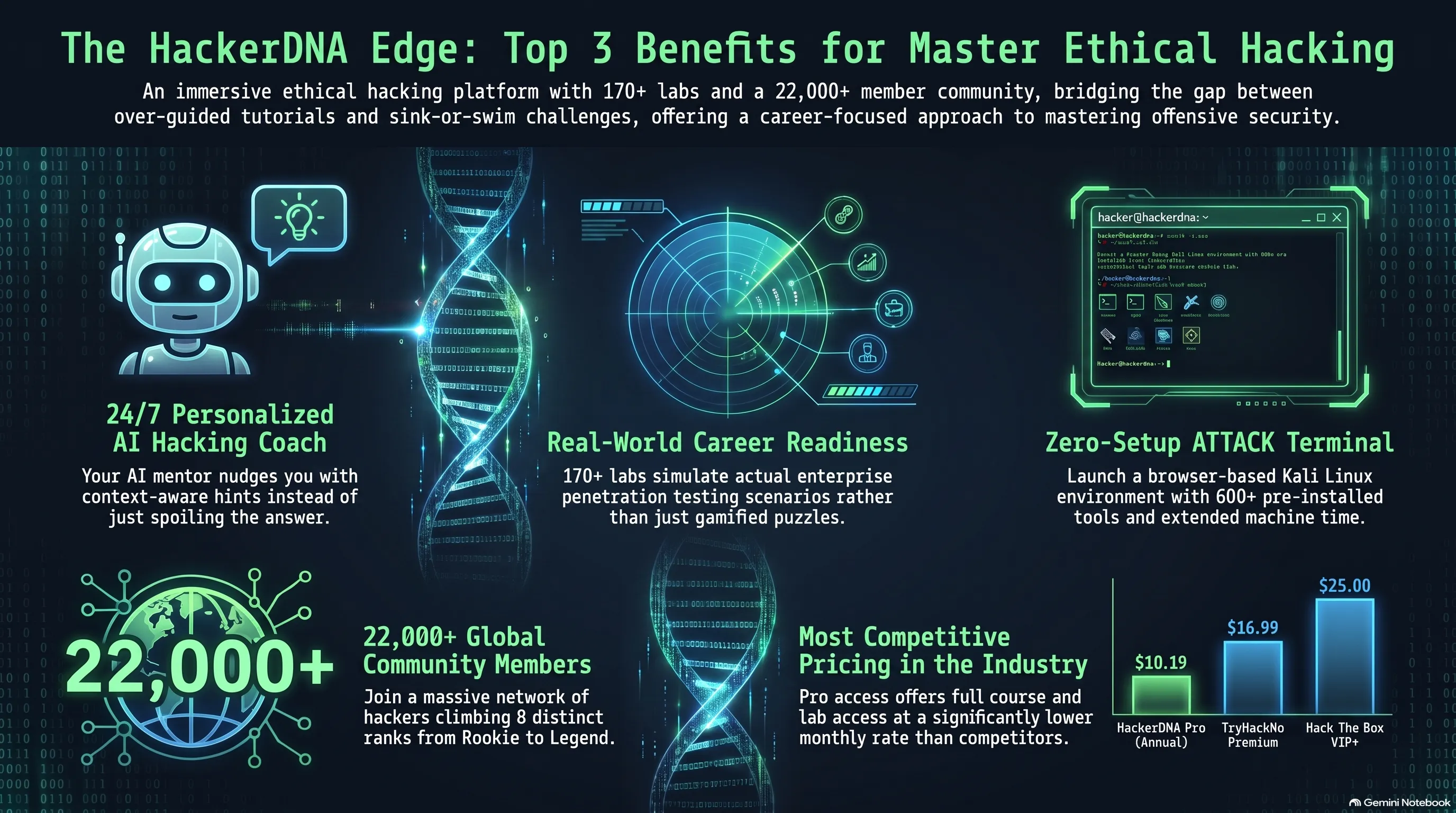
💡 Editor’s Choice: Striking the balance between independent problem-solving and smart guidance is why we recommend HackerDNA. Its integrated AI Hacking Coach delivers real-time nudges without spoiling the solve.
3. The “Web-First” Strategy: Start Where the Market Is
Hollywood insists that hacking is strictly low-level binary exploitation—scrolling assembly code and memory corruption. While binary reverse engineering is a valuable discipline, it has an exceptionally steep learning curve that stalls beginner momentum.
If your goal is practical career readiness, start with Web Application Exploitation.
You already interact with web architecture every day. You understand HTTP headers, authentication forms, URLs, and cookies. Transitioning to identifying vulnerabilities like SQL Injection (SQLi) and Cross-Site Scripting (XSS) leverages existing domain knowledge.
┌─────────────────────────────────────────────────────────┐ │ 2026 Recommended Learning Path │ └─────────────────────────────────────────────────────────┘ │ ▼
Web Exploitation ──► Start in the browser (OWASP Top 10) │ ▼
Cryptography ──► Decode ciphers, analyze hashes & tokens │ ▼
Forensics & Logs ──► Inspect packet captures (.pcap) & metadata │ ▼
Network Pentesting──► Enumerate services, lateral movement
Starting with web fundamentals allows you to notch early, motivating solves. In cybersecurity, early momentum beats raw genius.
4. Beyond the Flag: Why Write-Ups Beat Leaderboards
A #1 leaderboard rank without documentation is nothing more than professional vanity. Hiring managers and lead penetration testers rarely care about badges; they care about methodology.
A technical write-up proves:
-
You understand why an exploit worked, not just that a tool automated it.
-
You can communicate technical risks clearly to non-technical stakeholders.
-
You can formulate actionable remediation steps to fix the underlying vulnerability.
[ CTF Flag Solved ] │ ▼ [ Write-Up Documentation ] ──► (Vulnerability + Impact + Fix) │ ▼ [ Proof of Employable Skill ] ──► (Portfolio artifact for resumes)
If you cannot clearly document your methodology, you haven’t mastered the vulnerability. Treat every lab solve as a potential case study for your professional portfolio.
5. The 30-Minute Rule: Consistency Over Weekend Sprints
Hacking is a cognitive marathon. A common trap for beginners is grinding through exhausting 8-hour weekend marathons, hitting an impenetrable wall, and burning out.
Adopt the 30-Minute Rule:
- Dedicate 30 to 45 focused minutes every single day to solving one challenge, reading documentation, or reviewing another researcher’s write-up.
- If you are completely stuck after 30 minutes, step away. Let your subconscious process the problem while you rest.
- Study the official methodology or hint thread after you’ve put in the honest attempt.
Consistency builds long-term pattern recognition. Daily incremental solves keep frustration low and retention high.
6. The 2026 Training Landscape: Cost vs. Value
The cybersecurity education landscape has seen major pricing shifts. As legacy platforms increase subscription rates and phase out standard tiers, finding a platform that balances deep hands-on labs with reasonable pricing is essential.
| Platform | Monthly Price | Annual (Monthly Equiv.) | Platform Verdict |
|---|---|---|---|
| HackerDNA Pro | $16.99/mo | ~$10.19/mo | 🚀 Best Value: 170+ browser labs + 24/7 Socratic AI mentor. |
| TryHackMe | $16.99/mo | ~$10.50/mo | 🟢 Beginner Sandbox: Highly guided, best for day-one theory. |
| Hack The Box | $25.00/mo | ~$18.58/mo | 🔴 Advanced Tier: High difficulty and cost; built for seasoned pros. |
Choosing an educational platform is an investment in your career trajectory. Platforms offering built-in intelligent coaching allow you to progress through intermediate concepts without needing an expensive private tutor.
The Verdict: Take the First Step
The line separating aspiring security hobbyists from hired penetration testers is straightforward: the practitioners actually started.
The gatekeepers are gone, the browser-based labs are ready, and you no longer need expensive hardware to build genuine technical mastery.
Ready to launch your practical pentesting journey?
👉 Start your hands-on training with HackerDNA today and test your skills in live, browser-powered environments.